The Role of Puzzles in Enhancing Problem-Solving Skills in Children
Unlocking Young Minds Through Puzzles
Puzzles are not just a source of entertainment for children; they serve as a powerful tool for enhancing problem-solving skills. As children engage with various types of puzzles, they unknowingly cultivate critical thinking, patience, and creativity. This article delves into the benefits of puzzles, shedding light on their essential role in childhood development.
Why Puzzles Matter
Understanding the significance of puzzles highlights their impact on brain development and cognitive skills. From early childhood through adolescence, the engagement with puzzles can immensely shape a child’s mental framework. Here are some key reasons why puzzles are essential:
- Improved Cognitive Skills: Puzzles challenge children to think logically and strategize their next moves. For example, solving Sudoku or logic puzzles requires an understanding of number placement and elimination, which in turn bolsters mathematical reasoning.
- Enhanced Memory: Repeated problem-solving encourages retention and recall. Studies show that children who regularly engage in puzzles can recall information better than their peers who do not. For instance, remembering how pieces fit together in a jigsaw puzzle helps with spatial awareness and memory capacity.
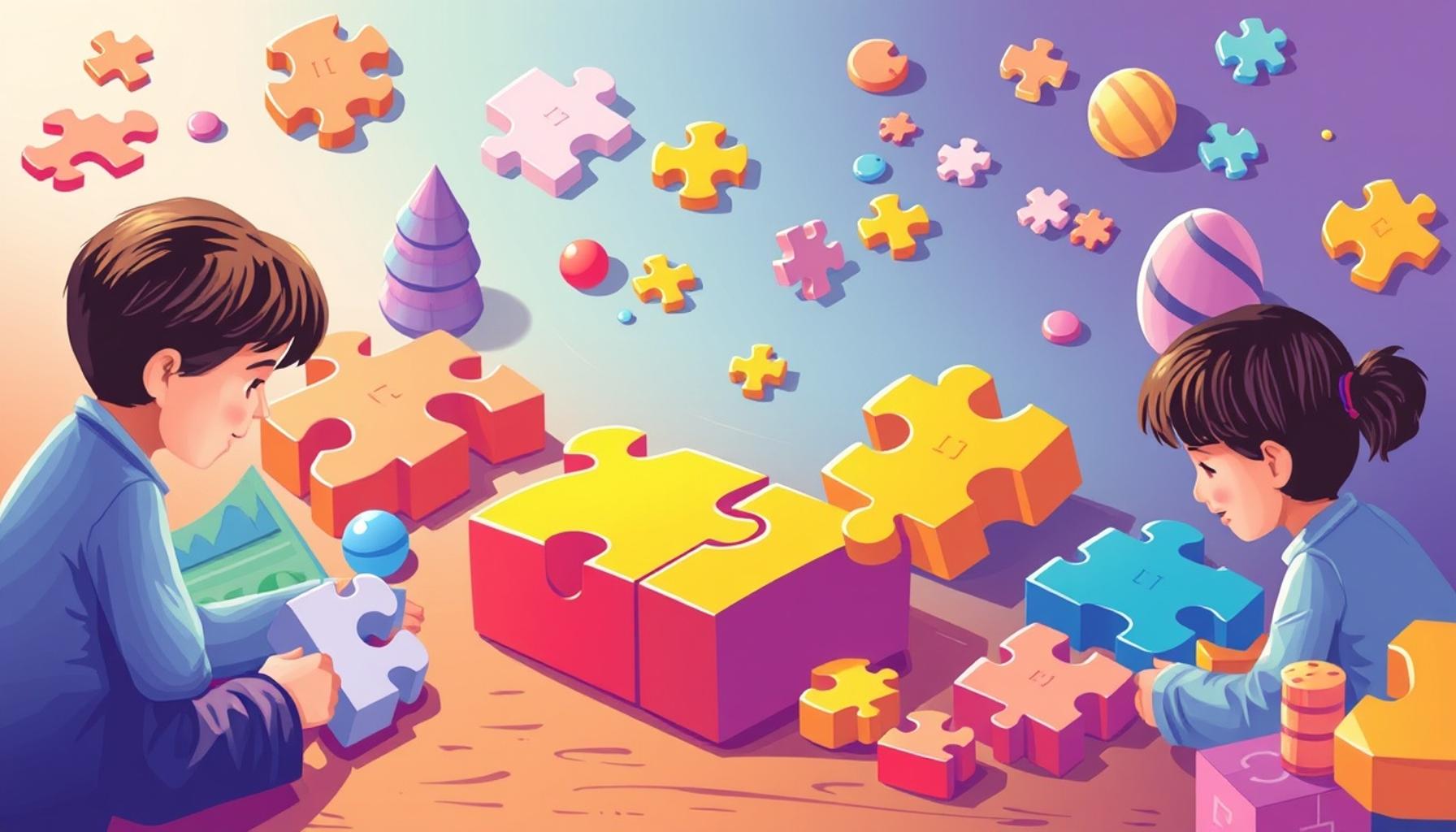
- Boosted Social Skills: Working on puzzles together fosters teamwork and communication among peers. Group puzzle activities in classrooms or at home can create a fun environment where children learn to share ideas, negotiate roles, and collaboratively work towards a common goal.
Puzzles in Action
From traditional jigsaw puzzles to modern brain teasers, children encounter a range of formats that suit different age groups and skill levels. Engaging with these challenges not only entertains but also instills valuable lessons:
- Resilience: Overcoming difficulties teaches persistence. When children face a particularly challenging puzzle, such as a 1,000-piece jigsaw, they learn that failure is part of the process and that perseverance is key to success.
- Creativity: Finding unique solutions enhances creative thinking. For instance, while working on a tangram, children are encouraged to come up with innovative shapes and designs, fostering out-of-the-box thinking.
- Confidence: Successfully completing a puzzle builds self-esteem. Finishing tasks, such as creating a complex origami model, provides a sense of achievement that reinforces a child’s belief in their abilities.
As we explore the fascinating link between puzzles and problem-solving skills, we unveil the true power of these challenges in shaping young minds. The cognitive and social benefits that arise from regular engagement with puzzles not only prepare children for academic success but also equip them with crucial life skills. Encouraging children to embrace puzzles today could lead to a generation of innovative thinkers and skilled problem-solvers tomorrow.
DISCOVER MORE: Click here to learn how strategy games boost creativity in companies
The Cognitive Benefits of Engaging with Puzzles
Puzzles have long been recognized for their ability to enhance cognitive skills in children. As children manipulate pieces, numbers, or shapes, they engage in a complex mental dance that exercises various brain functions. This multifaceted engagement is not just about putting pieces together; it’s about developing a skill set that can be invaluable throughout life. Here are some cognitive benefits that puzzles provide:
- Logical Reasoning: When faced with the challenge of fitting pieces in a jigsaw puzzle or answering a riddle, children practice logical reasoning. They learn to approach problems methodically, analyzing the information at hand before arriving at a conclusion. This ability to reason through problems is critical not only in mathematics but also in daily decision-making.
- Spatial Awareness: Engaging with puzzles significantly enhances spatial awareness. When experimenting with various shapes in puzzles like tangrams or 3D models, children learn to visualize and manipulate objects in space. This skill is particularly beneficial when they encounter more complex subjects like geometry or even navigation in their everyday lives.
- Concentration: Working on puzzles inherently requires focus and concentration. Children must train their attention spans, honing their ability to work steadily toward a solution. As a result, they develop better concentration skills that translate into improved academic performance across various subjects.
Research underscores the connection between puzzle-solving and enhanced cognitive development. For instance, a study published in the journal Cognitive Development found that children who regularly engage in puzzles score higher on tests measuring spatial skills compared to those who do not. This correlation indicates that the benefits of puzzles extend well beyond mere enjoyment; they play a crucial role in shaping capable, adaptable thinkers.
Social Interaction and Teamwork
While puzzles primarily focus on individual skill development, they also offer excellent opportunities for social interaction and teamwork. Group activities involving puzzles can foster collaboration among peers, a vital skill in both academic settings and future workplace environments. Through group puzzle-solving, children learn the importance of communication and shared goals:
- Cooperation: When children work together on a complex puzzle, they must cooperate to share ideas and devise strategies. This collaboration builds essential relationship skills that enrich their social interactions, reinforcing the idea that working as a team can lead to greater success.
- Role Allocation: During group puzzle activities, children often instinctively designate roles based on individual strengths—one may focus on edge pieces in a jigsaw, while another tackles the center. Such role allocation is a natural extension of problem-solving, encouraging children to recognize and value each other’s contributions.
- Conflict Resolution: Disagreements may arise during group puzzle-solving, providing an ideal environment for children to practice conflict resolution. Learning to navigate differences in opinion fosters emotional intelligence, a critical aspect of healthy interpersonal relationships.
These benefits not only illustrate how puzzles refine problem-solving skills but also highlight their capacity to reinforce social dynamics that are essential in modern society. By embracing the power of puzzles, we pave the way for children to not only excel academically but also thrive socially.
The Role of Puzzles in Enhancing Problem-Solving Skills in Children
Puzzles are much more than just a source of entertainment; they play a critical role in developing essential problem-solving skills in children. As children engage with various types of puzzles — be it jigsaw puzzles, logic puzzles, or even riddles — they are not just having fun; they are also honing skills that will serve them throughout their lives. Firstly, we must understand how puzzles encourage critical thinking. When children confront a puzzle, they must analyze the problem, envision their goals, and determine the steps needed to solve it. This not only boosts their analytical skills but also helps in fostering creativity as they explore different strategies.Moreover, puzzles enhance memory retention and cognitive abilities. As children remember shapes, patterns, and sequences in puzzles, they improve their visual-spatial skills, which are crucial not just in academics but in daily decision-making scenarios. Engaging in puzzles also teaches children about perseverance, as they often have to try multiple approaches before finding the right solution. Furthermore, working on puzzles can also involve collaboration and social interaction. Children can work together or compete against each other, allowing them to learn valuable teamwork skills, communication, and how to manage wins and losses gracefully. To further illustrate the benefits of puzzles, we present the following table highlighting specific advantages associated with different types of puzzles.
| Types of Puzzles | Benefits |
|---|---|
| Jigsaw Puzzles | Enhances visual recognition and spatial awareness. |
| Logic Puzzles | Encourages critical thinking and reasoning skills. |
| Crossword Puzzles | Improves vocabulary and cognitive flexibility. |
| Sudoku | Enhances mathematical skills and logical reasoning. |
Integrating puzzle-solving into regular activities can greatly contribute to children’s development, making it a valuable educational tool. From improving patience to boosting cognitive skills, the benefits of puzzles are undeniable, making them a fixture in early learning environments. The continuous exploration of puzzles and their effects on children only deepens the understanding of their vital role in not just learning, but also in fostering a proactive approach to problem-solving in various contexts.
DISCOVER MORE: Click here to learn about the benefits of puzzles
Emotional and Psychological Growth Through Puzzles
Puzzles are not only beneficial for cognitive and social development; they also play a significant role in nurturing emotional and psychological resilience in children. Engaging with puzzles can lead to a plethora of emotional benefits, which indirectly enhance problem-solving capabilities. Here are some essential aspects of emotional growth reinforced through puzzling activities:
- Patience and Perseverance: One of the most vital lessons children learn from working on puzzles is the importance of patience. As they grapple with challenging pieces that refuse to fit, they cultivate perseverance and understand that achieving a solution often requires time and effort. This lesson translates well into other areas of life—whether it be tackling a difficult homework assignment or mastering a new skill.
- Boosting Self-Esteem: Successfully solving a puzzle can give children a significant sense of accomplishment. This boost in self-esteem not only reinforces their problem-solving abilities but also encourages them to take on other challenges with confidence. Research has shown that the feeling of mastery can instill a desire to tackle increasingly complex problems, reinforcing a positive cycle of skill development.
- Stress Relief: Engaging in puzzles can also serve as a relaxing activity, helping children unwind and reduce stress. This stress relief is vital, as emotional well-being significantly affects cognitive performance. When children are relaxed, they are more open to creative thinking and problem-solving, which can lead to innovative solutions and approaches.
Studies have indicated that children engaged in creative and interactive activities like puzzles exhibit lower levels of anxiety and stress. A study conducted by the American Psychological Association found that children exposed to stimulating problem-solving tasks showcased improved emotional regulation, allowing them to better handle day-to-day frustrations and setbacks.
Enhancing Math and Science Skills
The relationship between puzzles and academic proficiency, particularly in subjects like mathematics and science, cannot be overstated. As children solve puzzles, they naturally apply various mathematical concepts and scientific principles, often without realizing it. Here’s how puzzles can specifically enhance skills in these areas:
- Critical Thinking in Math: Puzzles such as Sudoku, crosswords, and logic grids serve as excellent tools for enhancing mathematical reasoning. Children practice analytical skills as they deduce solutions based on previous clues and numerical patterns. By engaging with these puzzles, they develop a stronger foundation in mathematics, which is increasingly vital given the emphasis on STEM education in the United States.
- Scientific Method: Certain puzzles, particularly those involving patterns or sequences, help children understand the scientific method. By forming hypotheses about how puzzle pieces fit together, children learn to experiment, observe outcomes, and draw conclusions—essential skills not only in science but also in daily problem-solving scenarios.
- Engineering and Design Thinking: Building puzzles—think 3D puzzles or LEGO sets—invokes the principles of engineering and design. Tasks that require children to create and assemble structures delve deep into spatial reasoning and creativity. Such skills are foundational for future educational pursuits in engineering and technology fields.
The versatility of puzzles makes them a unique tool in both educational settings and at home, bridging the gap between play and serious learning. As children engage with puzzles, they unknowingly build a toolkit of skills that will serve them throughout their academic and personal lives, laying the groundwork for innovative thinkers and problem solvers of tomorrow.
DISCOVER MORE: Click here to learn about memorization techniques
Conclusion
In conclusion, the multifaceted benefits of puzzles in enhancing problem-solving skills among children are undeniable. Not only do puzzles foster cognitive development and critical thinking, but they also facilitate important emotional and psychological growth. The skills acquired through puzzle-solving—such as patience, perseverance, and self-esteem—play a vital role in shaping a child’s overall approach to challenges, both within academic settings and in everyday life.
The relationship between puzzles and academic proficiency, particularly in mathematics and science, highlights their essential role in nurturing future innovators. As children engage with various types of puzzles, they not only hone their analytical skills but also gain firsthand experience with the scientific method and design thinking, forming a robust foundation for continued learning in STEM disciplines.
Moreover, the calming effect that puzzles can have on children contributes to their emotional well-being, allowing them to better manage stress and anxiety. This psychological resilience nurtures creative thinking and opens the door to innovative solutions, characteristics that are invaluable in a rapidly changing world. With the increasing emphasis on developing problem-solving skills in today’s educational systems, integrating puzzles into children’s daily activities can serve as a powerful and engaging method to enhance their capabilities.
As parents and educators, recognizing the potential of puzzles as a tool for holistic child development not only enriches children’s learning experiences but also empowers them to become adept problem solvers in their future endeavors. Embracing puzzles is not merely an enjoyable pastime; it is an investment in developing the critical thinkers and innovators of tomorrow.